For many people, the word content feels generic, boring, almost meaningless. It sits right there next to “data.” But for me, it’s always been something much more personal. In a strange way, it’s been a kind of companion, something that has guided me my whole life. Without it, I’m not sure how I would have turned out.
The books, the music, the movies, the ideas I found growing up were where I went to understand the world.
Long before I worked in media or technology, I was the kind of person who spent hours roaming book and record stores looking for ideas and experiences that could help me live better. Music, books, movies, philosophy, self-help, stories, whatever form the content took, I was trying to find something real in it. Something that could change how I thought, how I saw the world, or how I showed up in my own life.
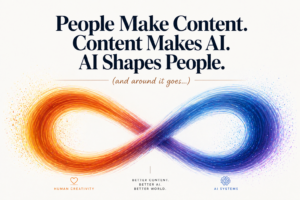
Over time, I realized that content is not just information. It’s one of the primary ways we learn how to think, how to make decisions, and how to understand ourselves and each other. It shapes society, and it shapes individuals. The content we spend time with influences us, often in ways we don’t fully notice while it’s happening. That’s always felt true on a personal level. What’s becoming clearer now is that it’s just as true for the systems we’re building with AI.
Looking back, it’s not surprising that I ended up working in this space. If content was shaping how I thought and understood the world, it was likely doing the same for others. I saw that as deeply important, and naturally felt drawn not only to create it, but to work with the systems that distribute it, value it, and determine how it reaches people.
Seeing the Coherence
My friend and consultant Tobin Trevarthen (https://shiftstory.co/) helps people see what he calls “narrative coherence,” and he often talks about how it becomes visible only when you step back far enough to see the pattern. Steve Jobs famously said, “You can’t connect the dots looking forward; you can only connect them looking backward.” I’ve been thinking about that lately, and when I look back across my own career, the pattern is pretty clear. Whether it was recorded music, digital downloads, streaming, apps, connected devices, voice AI, or now generative AI, I have almost always been working at the point where creative work meets new technology.
Like many people, I’ve had to rethink my own life and work as AI changes the landscape around us. What I’m doing now does not feel like a sudden pivot. It feels like the next version of the same work. AI is simply the latest system reshaping how content is discovered, valued, distributed, licensed, and experienced. The technology changes, the platforms change, the language changes, but the underlying question keeps coming back: how does content move through a new system without losing the value of what made it meaningful in the first place?
The Word Sounds Generic. The People Behind It Are Not.
The AI industry often talks about content as input, or simply as data. That language makes sense from a technical point of view, but it can also flatten what we are really talking about. Content is not just material to be processed. It is the accumulated work of millions of creative people trying to understand, document, explain, measure, imagine, inspire, educate, entertain, and improve the world.
It is music, books, research, archives, images, databases, journalism, reviews, educational material, cultural memory, scientific explanation, and countless other forms of human effort. When AI companies license content, they are not just acquiring data. They are deciding what kind of human knowledge their products will be built upon.
Beyond Philosophy: Product
And although this may all sound a bit philosophical, in AI it becomes very real. It defines the product itself. Systems grounded in truth, powerful stories, inspired music, real expertise, thoughtful analysis, accurate records, and well-structured information tend to be more useful, more trustworthy, and more distinct. Systems built primarily on fragmented, low-quality, scraped, or undifferentiated material may still sound fluent, but the experience can feel shallow or generic. The difference may not always be obvious in a demo. It becomes obvious when people actually use the system to learn, decide, search, explain, compare, or act, and increasingly, to guide how they think and perceive the world.
A simple product example: a travel assistant built on thin scraped summaries may still produce a cheerful three-day itinerary. It may even recommend “hidden gems,” which somehow always seem to be the same twelve places everyone else has already found. But a system grounded in current local guides, verified business data, transportation details, accessibility information, maps, editorial judgment, and lived human knowledge can actually help someone make a better trip. It can make the advice feel specific, useful, and alive. The interface may look similar. The experience of using it will not be.
Licensing Matters Now, and It Will Matter Even More
There is also a business reason to care about this. As AI tools become easier to build, the question will become less “Who has an AI product?” and more “Why would anyone trust this one?” One answer is content. The sources, archives, datasets, catalogs, and partnerships behind a system can shape what it is good at, where it is credible, and why it feels different from the twenty other tools saying very similar things in very similar voices. Feed every system the same generic, often-regenerated mush, and eventually the products start to taste the same.
For both AI companies and content/data companies, this creates an opportunity and a responsibility. High-quality, well-structured, rights-cleared content should not be treated as a commodity. And neither should the people who create it. It should be understood as a valuable strategic asset. A carefully maintained archive, a trusted news database, a rights-cleared music catalog, a deep educational library, or a well-structured product dataset is not the same thing as a pile of scraped internet confetti. In AI, those differences matter.
This is where AI companies and content owners need to stop treating licensing like a stack of paperwork no one wants to read. At its best, licensing is not just transactional. It is product-shaping. AI companies need to know what they are bringing into their systems and why. Content owners need to understand how their work creates value in an AI context. The space between those two perspectives is where much of the real work sits.
This Is Ultimately About People
There is also a larger human issue underneath all of this. High-quality AI depends on high-quality content, and high-quality content depends on the people and organizations who create it being able to sustain themselves. Writers, artists, musicians, journalists, researchers, publishers, archivists, and data providers do not produce valuable work by accident. They build it through years of practice, strange obsessions, late nights, revisions, dead ends, stubbornness, taste, discipline, and investment.
If those people and organizations are not compensated or supported, the long-term quality of the information ecosystem declines. That matters because AI is likely to become one of the main ways people access information, shape beliefs, form ideas, and make decisions. The content behind these systems is not just a technical ingredient or licensing asset. It is part of the knowledge environment people will live inside. Like the books and music that shaped me growing up, AI will help shape how people understand the world.
I keep coming back to this because I do not believe creativity is separate from technology. I believe creativity is what gives technology meaning. If we want AI systems that are useful, trustworthy, and maybe even a little less soulless, we should care deeply about what we are feeding them. The best AI products will not be built on scale alone. They will be built on better knowledge, clearer rights, stronger partnerships, and deeper respect for the human work underneath it all.
Ultimately, AI will influence people’s thoughts, beliefs, decisions, and actions. And those thoughts, beliefs, decisions, and actions will help create either a better world or a worse one. So yes, content matters.
And yes, it’s personal. It’s why I do the work I do.
