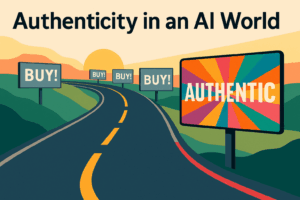
Like many people, I find one of the best ways to get the “pulse” of what’s going on in business is to scroll through my LinkedIn feed. Most of what you see is self-promotion (understandable — we all need to make a living), and often posts share something genuinely useful, something that helps me better understand what’s happening in the marketplace.
And sometimes, as I scroll down that endless LinkedIn highway, something else happens — something really pops. I feel like someone is speaking directly to me about something I care about in a way that makes me want more of it. So I’ve become a bit obsessed with spotting this kind of writing and asking: why does it touch me the way it does? What makes some voices so real while so much else comes across as generic, numb, and forgettable?
I decided to investigate.
According to a 2024 report by Originality.AI, more than half of long English-language posts on LinkedIn are now likely AI-generated. Authentic writing is becoming scarce, and as we all know, what is rare becomes valuable. What’s even more remarkable is how fast this shift has happened. For most of human history, writing was human. For more than five thousand years, since the Sumerians first pressed symbols into clay tablets, writing meant one thing: a person sharing thoughts with another person. (Ah, the good old days.) And now, in just the span of two or three years, that assumption has been upended. The speed of change is astonishing, almost incomprehensible in the sweep of history.
And why have so many people turned to AI to do their creating so quickly? I think it’s simple, creating is HARD. Writing and creating almost always involves struggle. In fact, in some ways, the struggle is the point. As a screenwriter and songwriter, I have spent hours chasing a single lyric or rewriting a scene until it finally rang true, and that effort itself is the magic. Searching for the perfect words or the right musical hook demands soul-searching. “The hard is what makes it great,” as Tom Hanks’ character said in A League of Their Own. Or as Hemingway put it more bluntly,
“There is nothing to writing. All you do is sit down at a typewriter and bleed.”
But here is the catch: it is struggle that creates depth. Without it, writing loses the originality that makes it human. New ideas don’t come from shortcuts; they come from the kind of internal work only people can do.
So where does that leave us? I do not believe the answer is rejecting AI. I find the tools incredibly useful. The real question is not whether to use them, it is how to use them without losing our voice.
For me, I call these “no cringe” rules and find a few practices help. I always start with my own ideas and write the first draft myself (I don’t ask AI what to write about — that’s my job). I write as though I am talking to one human being, not an audience. I do not aim for perfect; I aim for real. And before I finish, I ask myself: would I honestly get value from reading this?
Is it worth all the extra effort, the struggle? I say yes for several reasons. Not only is the content better (One 2025 LinkedIn content analysis suggested that AI-generated posts got about 30% less reach and 55% less engagement than human-written ones). But, there is more. Through the struggle of creation, you grow and expand; you become more creative, literally. And another beautiful thing is that authenticity spreads. Authentic thoughts lead to more authentic thoughts and creations. The world becomes more human and interesting — one authentic voice at a time.
I don’t know how this future world of creativity will unfold, and how rare authentic creations will become, but I do know this: as long as I keep putting pen to paper, and sit down at the keyboard to write a song, I’ll do my best to look inside, do the work, and share my soul with others. Because to me it is, and will always be, worth the effort. Without it, we risk a world of noise without real human connection. And how lonely that world would be.
====
If this subject interests you, here are a few books worth exploring: The Creative Act by Rick Rubin, on creativity, presence, and authenticity; The Way of Integrity by Martha Beck, on the courage of telling the truth; Unmasking AI by Joy Buolamwini, on protecting what is human in a machine-driven world; The Coming Wave by Mustafa Suleyman and Michael Bhaskar, on the speed and scale of AI change; and Hello World by Hannah Fry, on being human in the age of algorithms.
